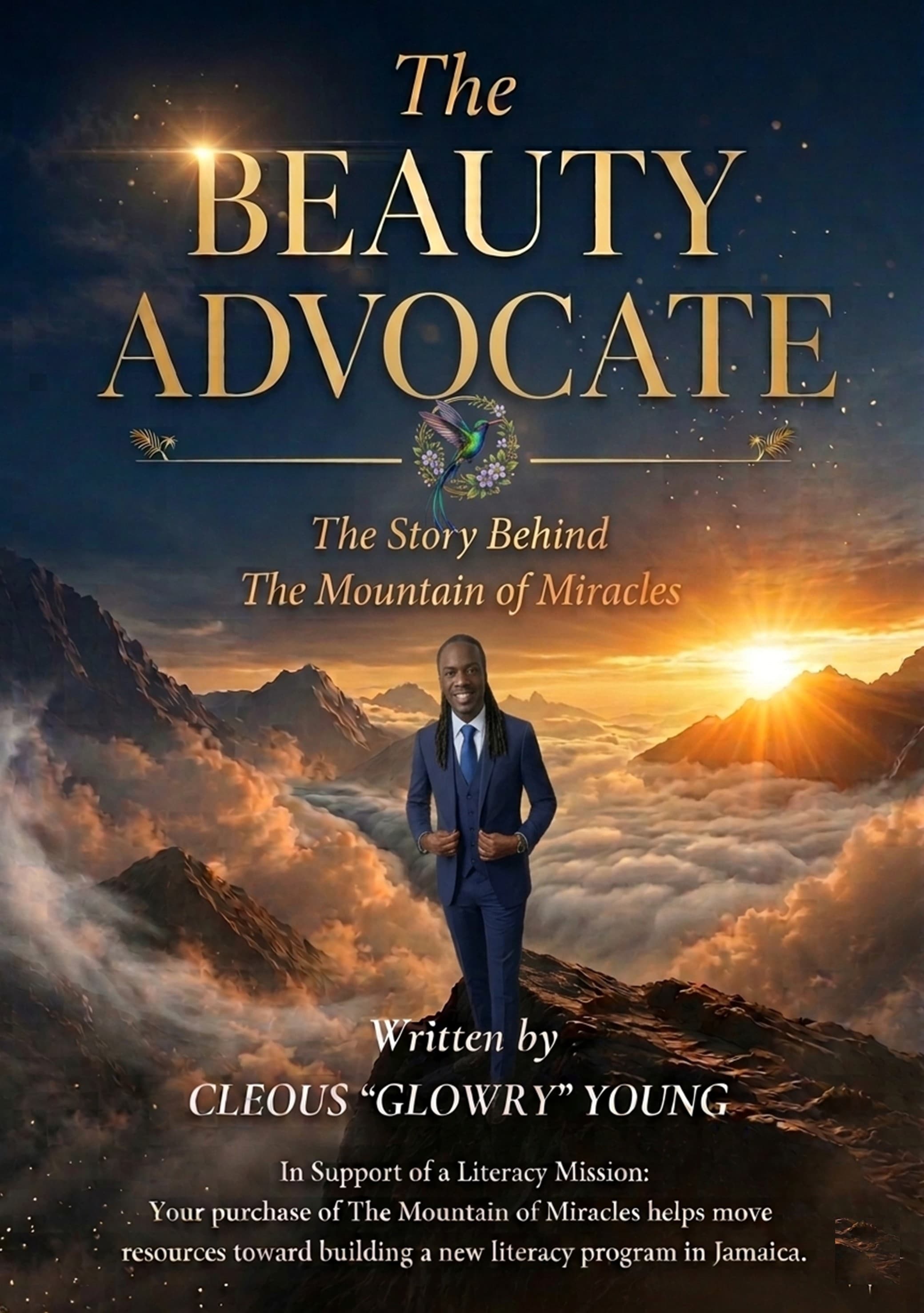
The Beauty Advocate
The Story Behind The Mountain of Miracles
Written by Cleous “Glory” Young
In Support a Literacy Mission:
Your purchase of The Mountain of Miracles helps move resources toward building a new literacyprogram in Jamaica.
Most people think of Beauty as something you frame, photograph, or apply—an aesthetic you can see at a glance. But as a Beauty Advocate (BA), my work is more molecular than cosmetic. I pay attention to what happens to a person’s posture, presence, and spirit after they’ve been spoken to. I listen to the words we release into rooms that are considered closed environments— because words don’t just describe reality. They shape it.
What is a Beauty Advocate?
A Beauty Advocate (BA) is someone who treats beauty as an ascension beyond physical appearance. A Beauty Advocate protects the emotional atmosphere of an environment—using language, respect, and dignity as daily practice. A Beauty Advocate advocates for the way we speak to children, elders, neighbors, strangers, and ourselves, because words can either nourish the mind or drain it. When people are repeatedly treated with cruelty or contempt, the mind can become depleted over time—sometimes to the point where additional, professional support is needed. In other words, the way we treat others can contribute to the weight they carry internally.
I began this Beauty Advocate journey after witnessing something that stopped me cold: someone with undeniable facial and bodily posture beauty, yet their language—violent, degrading, and ugly—seemed to dim every bright feature on their face or posture. In that moment, I understood how words can do two kinds of damage at once: they can wound the person receiving them and also distort the beauty of the person releasing them. I also realized something I couldn’t unsee. Beauty isn’t only in the eyes of the beholder; it’s also in the emotional frequency of the words we carry and the tone we use to hand them over to someone else. Those frequencies are often shaped by adverse childhood experiences that build inner mountains over time. If those mountains are never addressed, outer beauty can be overridden by the internal “ugly” words that quietly script a person’s choices, relationships, and future.
The science that made me look twice
I was especially moved by the work of Dr. Masaru Emoto, whose water-crystal photographs suggest that water exposed to words like “Love” and “Gratitude” forms intricate, snowflake-like patterns—while water exposed to phrases like “Hate” or “You disgust me” appears distorted and chaotic. Whether you read his work as metaphor, mystery, or message, the takeaway is clear:what we speak has impact. And because the human body is often described as being roughly 60% water, it’s hard not to wonder what unkind language does—quietly, repeatedly—to the inner climate of a person’s well-being and social interaction. We talk about “mental health” as if it’s a localized storm in the brain, but I’ve come to see it as the weather forecast of the whole body. When we treat each other “ugly”—with cynicism, sharp tongues, and dismissive glares—we aren’t just bruising feelings. We’re creating the turbulence of shaping what people believe about themselves. The Wilted Child. A boy disciplined with “ugly” words learns to fold inward. You can see it in the shoulders, the eye contact, the way confidence disappears. The body keeps a record of the language it lives under—what we store as memory and replay as belief.The Graying Neighbor. An elderly woman who hasn’t heard a beautiful word in weeks doesn’t only feel lonely—she can look depleted. Not because of age, but because affirmation is a form of nourishment. A community can dehydrate people without ever touching a faucet. That’s why I committed to being a Beauty Advocate—an advocacy of Beauty as a lived practice. My work is simple, yet radical: I remind people that Beauty—expressed through words, attention, and dignity—isn’t just an aesthetic. It’s a necessity that supports life, liberty, lifestyle, humanity, livelihood, and maturity. Beauty encourages the spirit to live and not die. It parades joy to the heart and supports the brain’s capacity to shift, heal, and grow—what science calls neuroplasticity.
“Your tongue is a sculptor. Every conversation is carving something—either a masterpiece or a wound.”
If harsh words can distort how someone sees themselves in a single moment, imagine what a lifetime of “ugly” treatment can do to self-image—and to the pathways the mind walks every day. Beauty influences the mind because language becomes inner dialogue. And when that inner dialogue is filled with repeated insults, shame, or degrading memories, it’s only a matter of time before the inside starts to fray. This is the In-Prison of your own imprisonment: the cell built from the words you rehearse until they sound like truth. As the African proverb says: “When there is no enemy within, the enemy outside can do you no harm.”I once stood beside a young man who had spiraled into a deep depression and had a suitcase- body filled with self-harm. The vocabulary he used for himself was relentlessly “ugly”: failure, burden, mess. He spoke about one episode in his life—one that came dangerously close to suicide—as if it were the full definition of who he was. It was the enemy within, doing its work. No matter how thoroughly I tried to help him repaint his story, he could only see the ugliness he packed in his suitcase-body. But to me, the fact that he was still alive was beauty—because death is ugly, and he did not arrive there. He arrived at painful circumstances, then replayed them day after day, without realizing what repetition can do to the body and mind. We don’t only remember language. We live inside it.
A “Beauty Census” we rarely take
The heartbreaking part is that he isn’t the only one. There’s a real need for more Beauty Advocates—because if we took a “Beauty census” of the neighborhood, we’d count trees and flowers. We’d count beautiful faces, vehicles, homes, and blocks. We’d measure what we can point to. But we rarely count verbal interactions—the daily exchanges that either elevate a person or erode them. Too often, we’re trained to notice what’s wrong first: dishonesty before kindness, danger before safety, poverty before security. When ugliness becomes “normal,”Beauty starts to feel unusual. Beauty Advocacy exists to shift that pattern—to make Beauty common once again.
How The Mountain of Miracles grew from this work
This is the heartbeat behind The Mountain of Miracles. In the story, I don’t hide ugliness—I show what it looks like when it arrives as greed, when it hardens into a monster, when “the evil doer” starts moving through the night. But I also chose something else: I allowed Beauty to have the final word. In many ways, it’s a reversal of the old “Beauty and the Beast” story—because here, the beast must confront itself, and the ending is shaped into something miraculously beautiful. That is the true exposure of the environment ofThe Mountain of Miracles. You’ll notice how the villagers speak kindly to each other. You’ll notice how “Respect” is the principle they practice—and how miracles unfold when they come together. So, my Beauty Advocacy isn’t random—it’s the root system ofThe Mountain of Miracles. The story is rooted in Beauty and, through its trials, bear beautiful fruits that look like miracles. And one of the most tangible miracles we’re working toward is this: raising funds and resources to support a new literacy initiative in Jamaica. In a world where generational hardship can replay itself like a forecast, helping children and adults to become literate in the 21st century is a beautiful act of interruption.
In the pages: a story where ugliness is confronted, beauty is reclaimed, and miracles are more than a word—they’re a turning point.
In the real world: support for literacy resources that help children and adults read, learn, and build futures with more options.
In the reader: a reminder that language matters—and that we can choose words that leave people clearer, not cloudier.
A paradigm shift isn’t instant. Even when you glimpse something better, it takes time to marinate—time to become a habit instead of a moment. But when a community starts treating each other with aesthetic grace—patience, active listening, kindness, forgiveness, and soft answers, just like in The Mountain of Miracles—something begins to stabilize. People feel clearer because their nervous systems aren’t constantly bracing for impact. Anxiety loosens its grip. Isolation breaks, because Beauty is magnetic; it draws people out of their shells and strengthens inner life. Science calls some of this neuroplasticity: repeated experiences and repeated language that shape the brain’s new pathways. Faith has long named a parallel reality: the renewing of the mind. In some religious contexts, we call this an “anointing.” Once the character received back his anointing inThe Mountain of Miracles, Beauty began to unfold—sometimes beyond what the character could immediately understand. That’s the power of Beauty: it can reach beyond our cognitive awareness and embraces what we become.
Now, the ugliest thing in the world isn’t a face, a home, a vehicle, a place, or even death. The ugliest thing is the shape we leave someone’s soul in when we use words that demean and dismantle their mind and spirit.This is the In-Prison of your own imprisonment—and the key is often the words we choose next. Break yourself free of mountainous emotional wounds by renewing what you rehearse: your self-talk, your tone, your daily language. What you repeat becomes what your mind expects, and what your body prepares for. And yes—let your faith begin to move these mountains, while you practice the small, consistent steps that make change measurable: truth spoken aloud, support received, and healthier patterns built. Over time, Beauty can become an inner nature—not just a moment.
So here are my questions for today: Did you offer a beautiful greeting? Did you acknowledge someone’s existence with dignity? Did your words leave the room brighter than you found it? And did you support something beautiful today?
Once again, we kindly ask for your support:
of this Literacy Mission:
Purchase The Mountain of Miracles and help move resources toward building a new literacy program in Jamaica—while spreading “BEAUTY” through your community.